

September, 2021. The Verkhovna Rada of Ukraine adopts Bill No. 3427 “On Amendments to the Law of Ukraine “On Advertising” to Combat Discrimination on the Basis of Gender”. Accordingly, the Law “On Advertising” includes a new definition of the concept of “discrimination” and the amount of fines that brands and advertising agencies that resort to sexism must pay. However, half a year passes and the National Council of Ukraine on Television and Radio Broadcasting concludes: a quarter of advertising on nationwide channels is gender-unbalanced. Even a direct ban and fines do not motivate advertisers to advertise without sexism. Has it always been like this, or did sex not sell at one time?
It is difficult to imagine the modern world without advertising, even despite the fact that during the full-scale invasion, its volume has significantly decreased. We see it on TV, hear it on the radio, see billboards along the roads, in transport, in the feed of social networks.
Advertising is everywhere — let’s look chronologically at the history of its development in Ukraine and its relationship with sexism.
1990s, 2000s, 2010: the formation of the advertising market and sexism on it
In 1992, the Internet and the ua domain appeared in Ukraine. At the same time, the ICTV, TET, and U2 television channels went on the air. This year can be considered a milestone for the Ukrainian advertising market. Newspapers and magazines existed in parallel — more than 2,000 different publications, including even the first fashionable women’s magazines.
The 1990s in Ukraine were a time when many spheres emerged. A lot of printed publications were inherited from the USSR, and they began to gradually develop and expand them. New channels appeared on television, and the cultural sphere — music, cinema, and art exhibitions — was developing. There were no frameworks or templates yet.
60–70% of advertising was in print media, the rest was on television. Television was dominated by advertising for foreign goods, designed for the Western consumer. This was primarily due to the fact that filming video advertising required large amounts of money, which was simply not available. In conditions of shortage, truly necessary everyday goods were purchased without advertising, and if they were used at all, it was more often in printed form – newspapers, signboards, flyers and business cards.
Since the beginning of the 2000s, the now-famous TV channels “Ukraine”, “Inter”, “1+1”, “STB”, “Novyi Kanal”, radio stations “Lux FM”, “Hit FM”, “Radio Chanson” have been operating. The advertising that was broadcast on them was mainly Western, translated, but not adapted for the Ukrainian consumer. Most of the advertised goods were products: chewing gum, chocolates, candies, sweet drinks, baby food. That is, everything that was not yet part of everyday goods, but there was a great desire to make them so. If the advertisement had one main character, then usually a male expert image was used. The man recommended a magazine, product or service. For general consumer goods, the image of a family was used: happy children eating sweets or a married couple preparing fragrant soup.
It is difficult to trace the manifestations of sexism here. One of the few advertisements with a hint of sexualization is an advertisement for Cadbury chocolate, where the camera focuses on a woman’s lips in close-up, as if trying to evoke an association of pleasure.
There are also completely atypical images. For example, a daring policewoman in an advertisement for Stimorol chewing gum: she is the first to court the man whom, according to the plot, she stopped for a violation.
Changes in the 2021 law and the ban on using sexism in advertising are just one step in the history of legislative permits and prohibitions in the marketing sphere.
In 1993, an advertising tax was introduced. For one-time advertising placement — 0.1% of the fee, for permanent — 0.5%. In 1996, the well-known law “On Advertising” was adopted, which has been supplemented more than once. For example, today not only discrimination is unacceptable, but also products that are harmful to health are unacceptable for advertising — alcohol, tobacco.
In the second half of the 1990s, Ukrainian advertising becomes more, but it is very chaotic. The law does not regulate the content much, directors juggle different sketches: someone copies European advertising, someone transfers scenes from the KVN into advertising, and someone tries to come up with something new and unusual. The focus of attention is on the idea. Often, advertising was “bought” with a plot, rather than with specific visual images or aesthetics, which gravitate towards sexualization.
“Family”, which is so abundant in advertising in the 1990s and which arouses admiration, in the 2000s began to be overexploited. Television advertising can be conditionally divided into several categories according to products: pharmacological products (medicines, dietary supplements, auxiliary drugs), household goods (washing powders, detergents, some appliances), food products (this also includes sweets, baby food, etc.) and other (delivery services, mobile communications, banks). Social advertising commissioned by the state and election campaigning can be distinguished separately.
Advertising for household products used family images the most, and along with them, stereotypical roles. A housewife has to do the housework: wash dishes and floors, put laundry away, and at the same time take care of children. Men are usually absent or completely absent from such advertising.
, or existed as a background for several lines of dialogue.
The famous advertisement for the floor cleaner “Mr. Proper” is interesting in this regard. The concept was criticized, saying that Mr. Proper is an idealized male image that every woman dreams of: he is conventionally handsome (although depicted in a cartoon style), pumped up, knows how to clean quickly and efficiently and does it. In fact, the advertising of this brand is one of the most successful in terms of overcoming stereotypes. For example, in the 1994 advertisement, only a woman cleans, there are no other characters. In 2003–2009, both a man and a woman clean. There are variations of the advertisement where a father and son take on the cleaning task so that the mother comes to a clean apartment, or where the father instructs his teenage son to clean the kitchen. As we can see, there is no stereotyping.
Another commercial for dishwashing detergent “Fairy” tells about a dinner meeting of the Petrenko family and their neighbors. The men in the frame are eating, the women are washing the dishes. In the commercial from another year, with the Kovalenko family, a mother teaches a teenage girl to wash the dishes; in another commercial from this period, a mother-in-law teaches her daughter-in-law this difficult task.
Is this sexism? It is difficult to say for sure. Indeed, even now, not to mention the zero years, most of the household chores fell on women’s shoulders, so such advertising is more a reflection of reality and familiar role models for many. When such plots are present in the advertising of almost all products, it only confirms the correctness of reality and consolidates it.
Gala, Tide, Drug, Perwoll, and even Bosch dishwashers — all of these brands have been actively using images of women washing clothes, cleaning apartments, and washing dishes in their advertising for years. Male images were not included in this sample.
The people who developed the Ukrainian advertising market were not professionals. They achieved everything by trial and error: trying to make a joke, trying to shoot something aesthetic, trying to tell about a product through a poignant or close story. Gradually, with the development of radio and television, and later the Internet, all this began to form into large media holdings and advertising corporations.
From the mid-2000s, wireless Internet appeared in Ukraine, the digital era began, and later Internet advertising developed, which we will return to later.
Technological progress cannot be stopped. Brands began to cooperate with each other, attract international experience, and turned to specialists for advertising. The number of products grew. The decade from the 1998 crisis to the 2008 crisis was the heyday of the advertising market, which almost doubled. In 2007, about 20% of Ukrainians used the Internet, and in 2012 their number reached 50%.
But for now, let’s talk about television, because it was it that became the basis for the development of video advertising on the Internet. An interesting area is advertising for the pharmacological group of products. Even during the full-scale invasion, pharmaceutical corporations were the first to return to the advertising market after a break. As of June 2022, 80% of advertisers and 90% of advertising in the media space belonged to them. The reason is simple: no matter what happens, medicines are always needed.

The plot of such advertising is usually simple and does not require adaptation to new realities. Before the full-scale war, pharmaceutical corporations also took the maximum of the advertising market. Given such a wide representation, this advertising will definitely attract our attention. And here it gets interesting.
It would seem that advertising for pharmacology is the simplest, because we all need various medicines and support for our health from birth to old age from time to time. Therefore, advertising covers the maximum of the target audience. However, women prevail in it, and it is also aimed at women. And this is not only in advertising for painkillers for menstrual pain or medicines for children. The entire industry exists as if treating an entire family is a woman’s business. Although it must be admitted: there are exceptions, but they are rare.
The advertising for the drug “Citramon Darnitsa” in 2018 caused an ambiguous reaction in society. According to the plot, two companies are sitting next to each other in a cafe: one is completely female, the other is male. The men are discussing among themselves what is most important in a woman. One for good looks, the other says that a woman should take care of her family, the third considers the most important thing in a relationship to be a woman’s love for her man. A woman from a neighboring company intervenes in this conversation, she holds out a package of advertised pills with the words: “The main thing is that a woman does not have a headache.” This advertisement contains a metonymic reference to a folk joke, which says that a woman always has a headache when she does not want to have sex.
Everything is clear about stereotypical roles. Advertising actively exploited them in such a way that we did not even notice it, because we understood this state of affairs as the norm at that time. And what about sexualization?
One of the first in Ukraine to openly use a naked human body was the advertisement for “Bounti” in 2001. A slender girl in a swimsuit lies in a hammock on the ocean shore and receives “paradise pleasure” from a chocolate bar. At the same time, the camera captures her entire body, breasts, bikini line and how the girl directly eat candy.
The next such advertisement that was remembered by the audience was the chocolate desserts “Bonjur”. This is probably one of the loudest cases in the entire history of Ukrainian television: in addition to the conventionally ideal male body, the slogan of the advertisement sounded like “Bonjur. All for the sake of female pleasure”. The sexual overtones were not hidden at all, and it was such an unexpected and daring decision that the advertisement quickly entered the TOP.
To repeat such an advertisement immediately (the events take place in 2006) is to copy the decision and style, which few brands dared to do. For example, the “5 Golden” crackers tried to use the sexualized image of the female body in the same frank way, in the advertisement of which, under the words “thoroughly fried and saturated”, young slender girls in swimsuits are shown
And “Mobilochka” went even further: in its advertisement, a woman is ready to give herself to a man for a new phone.
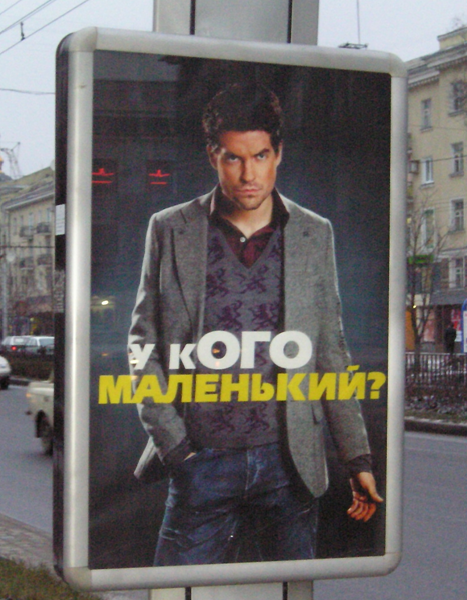
As we can see, such advertising did not prevail in the market, but its rapid flourishing began. It seemed like a bold decision: to talk not about the product, but about the hidden desires and pleasure that the product could potentially bring. Gradually, this began to be used more and more often, and not only in television advertising. Billboards simply adored sexism, here are some examples of typical old advertising.
In 2005, YouTube appeared, and since 2007 it has been gradually monetized. In 2006, the Russian social networks VKontakte and Odnoklassniki.ru appeared, which were actively used in Ukraine, and the American Twitter (now the X network). In 2010, Instagram joined them, so we can talk about the era of digital marketing.
And therefore, more and more advertising is being made comprehensive. There are a lot of products, advertising platforms too, it is very difficult to cover them all, but companies and businesses are trying, giving more and more money to agencies. Given the number of brands and money in the industry, it is difficult to come up with something completely new. Some advertising was taken from Russian television (which was generally typical at that time, as well as the same entertainment shows, films, series, etc.) and simply translated or subtitled; they constantly turned to stars and famous people to become the face of the brand.
However, the use of a naked body (mostly female) and allusions to sex were so obvious and repetitive that already in 2013 such advertising was called low-grade and clichéd, they said that it harmed business, not helped.
They even conducted sociological studies to determine what women and men pay attention to if they see a naked woman on static advertising (billboards, flyers, leaflets). Thanks to them, more than a decade ago, in the early 2010s, it became obvious that such advertising is not memorable. Men are more likely to look at the model’s face, women – at the whole body, consider the figure, clothing (if it is at least partially) and manicure. None of the respondents remembered the type of product or a specific brand.
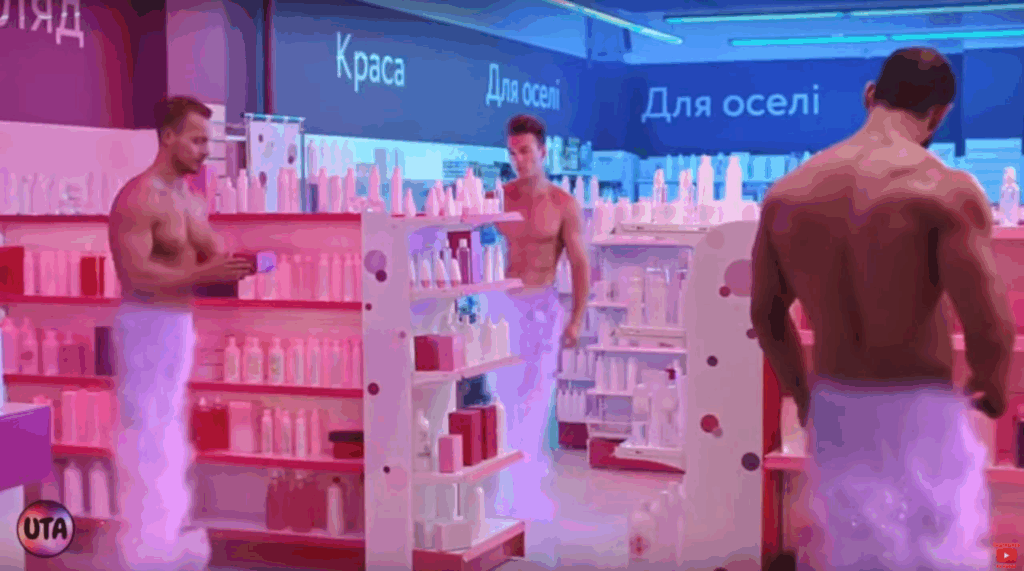
However, this did not prevent television from following the beaten path. Let’s recall a few more high-profile cases from a period closer to us. Over the past six years, we can recall many cases of obviously sexist advertising on television. For example, “Prostor” (“Space”) and the embodiment of desires, this is 2017.
The advertisement almost completely copies the famous “Bonjour”: conventionally beautiful men demonstrate their naked torsos and embody women’s desires, ready to do anything for the sake of female pleasure.
Why did advertising continue to follow the path of sexism, even though it was becoming typical and contradicted research on effectiveness?
Maidan as a turning point
2012–2013 is a time of oversaturation with advertising and marketing. As already mentioned, the Internet has been at the peak of user activity since its appearance in Ukraine. Television and radio broadcasts are broadcast around the clock, technological progress allows you to create bright and dynamic commercials that begin to tire you, advertising is more likely to annoy rather than entertain. In addition, in 2012 Ukraine will host the European Football Championship, which will transform urban spaces (especially Kyiv, Donetsk, Kharkiv and Lviv, where matches were held in stadiums) into everyday advertising platforms.
The Revolution of Dignity affected everything. The political and economic crisis led to the collapse of the Ukrainian advertising market. Marketing budgets were significantly reduced, and devaluation took place. In the eastern regions and in Crimea, people are not into advertising at all – sales are falling.
But besides the obvious consequences of the crisis, there are others – the emergence of new media and the emergence of a fashion for everything Ukrainian. What we call today “gentle Ukrainization” took place: new resources appeared (for example, “Hromadske”), which quickly reached more listeners than television in general that year. The marketing sphere is increasingly switching to the Ukrainian language, brands are starting to use national authenticity. It would seem that this is a convenient moment for the death of sexism, but no.
Fewer and fewer people trust television, which leads to a reduction in advertising budgets and the number of advertisements. The main category of goods is pharmacology with the typical plots listed above. In second place is social and advertising and advertising designed to draw attention to the Ukrainian army. Brands are irrelevant on state broadcasting (we will see a repeat of this in 2022 with the creation of the Unified News Marathon), so they move to social networks, and this is convenient. For advertising, they use both static images and videos previously shot for TV format, collaborate with influencers and opinion leaders.
Feminist optics are strengthening. People no longer consider the use of a naked body or fat hints in advertising to be the norm. The flourishing of social networks helps: the more attention is paid to cases of sexism, the sooner official media will write about it. We can conclude that the marketing institute of reputation is forming, but still some brands resort to sexism in advertising not because they do not understand where the line is, but because they know that they can outrage, and black PR is also PR.
High-profile cases included a billboard in Lutsk advertising the “World of Leather and Fur” stores, and a scandalous social media ad for a pizzeria in Rivne.
Such advertising, such as the latest case, could exist exclusively on social media. There is no law banning sexism yet, but television is more cautious, and radio broadcasting is limited to purely advertising slogans, without any visuals. At the same time, social media, which has no control whatsoever, creates a feeling of permissiveness: creating an ad with a reference to a well-known pornographic video is bold, although outrageous. The half-naked men from the “Prostor” ad seem like something trivial in comparison, and television uses this. These were the three advertising spaces not long ago.
Social media, which have their own influencers and everyone tries to cooperate with them, are also not controlled by the state (with the exception of Russian resources that were blocked in Ukraine). You can do literally anything, attract attention in as many ways as possible. The naked body is becoming a popular way: the Internet is more relaxed than in real life, and even if someone is outraged by it, he or she will still comment on the advertisement. Social media algorithms have always worked like this: the more attention a post receives, the more it will be shown to other people. Television cannot afford the same relaxedness as the Internet, but all the old methods are preserved there: a half-naked body, erotic hints or actions, ambiguous slogans. Against the background of the Internet, it is not daring, so it hardly attracts the attention of the community. It is not that such marketing is beginning to be tolerated, but it is perceived to some extent as something inevitable, because the idea that sex sells has become commonplace. Moreover, if the brand is completely Ukrainian-language, not connected with any cooperation with Russia and supports the army, no one dared to criticize the advertisement at the beginning of the war. We saw this repeated at the beginning of the full-scale invasion and even now: illegal advertising is justified by paying taxes.

Billboards and flyers are becoming fewer in the digital age, but they are not disappearing. Most often, as independent advertising, they are not very successful, so they are used as an auxiliary method. They have the same images as in television or online advertising, the slogan is in large font and the brand is indicated. If the billboard is sexist, it is worth looking for a television advertisement for this brand, most likely it is even worse. A completely naked body in urban space was not very well received, but veiled hints were loved.
At the same time, quite feminist advertising appears, such as the collaboration of the brand “bra bra bra” with the rapper Alyona Alyona.
What the full-scale war changed
During the period of the full-scale invasion, Ukrainian brands are experiencing not the best of times. Many people have left, the economy is unstable, most of the money of every company and every person goes to providing basic needs and supporting the army. Marketing has had a hard time adjusting to this new era. We have many successful advertising cases, for example, the New Year’s ad of Nova Poshta, which was remembered by everyone for its sincerity. However, there is also a lot of sexist advertising, although it is now illegal, despite the outrage on social networks and in the media, despite what has become obvious: vulgarity does not sell.
If you are an ordinary citizen, do not tolerate sexist advertising. Yes, it no longer attracts attention and the brand is not remembered, but it is worth writing a complaint so that the marketing department understands: sexism is not black PR, it is bad form and an obstacle to business.
For more information on how to write a complaint about sexist advertising, read Kateryna Viter’s article “How and why to fight sexism in advertising.”
If you are creating an advertisement and are not sure whether it is sexist, check yourself with the advice in Alena Gruzina’s article “How to prevent sexism in advertising: five practical tips from Gender in detail”.
This project is implemented with the support of the Swedish Institute.



Leave a Reply