Derogatory sexist statements by Ukrainian politicians of various levels are still not uncommon in Ukrainian political culture. Yes, it must be admitted that over time there are fewer and fewer of them. Moreover, as soon as they gain publicity and become known to the general public, they are immediately subjected to devastating public criticism and condemnation, and this criticism is increasingly massive and influential. Society is better at identifying manifestations of sexism and more resolutely condemning them. This may indicate that we are gradually moving away from traditional patriarchal attitudes, and egalitarian views are becoming more and more firmly entrenched at the level of the social norm.
Probably, that is why fewer politicians resort to open hostile sexism. However, among deputies and civil servants of various levels there are still those who, in a veiled form, under the guise of “good intentions”, express theses that can be identified as “benevolent” sexism. After all, there are still a few politicians who are not ashamed of their sexist position and discriminate against women in an aggressively hostile manner.
After a sexist comment or act gets on TikTok or Ukrainians’ news feeds and spreads, it is interesting to observe the reaction of the main sexist character. Here, various strategies are traced – from self-defense and justifications to an active attack, accompanied by new sexist pearls. The reaction of a sexist to accusations of sexism is the main subject of research.
Usually, this reaction allows us to better understand how deep the author’s convictions are in the correctness of his words and actions. It also helps us understand what the author thinks about the phenomenon he is accused of. It is logical to assume that those for whom the criticism was convincing enough and the accusations were fair will at least admit that they were wrong and apologize. On the other hand, those who firmly adhere to their sexist beliefs and believe in their correctness will defend their position to the end and will not see manifestations of sexism in their actions / words.
Using this approach, it will be possible to assume how those who resort to it (do not) understand and interpret the phenomenon of sexism. Of course, this study does not claim to be representative, so its results and conclusions are inappropriate to extend to the entire Ukrainian political sphere. Let us consider here only the most striking cases of sexist statements and actions over the past few years.
Flowers as a “friendly gesture” of an apology for sexism
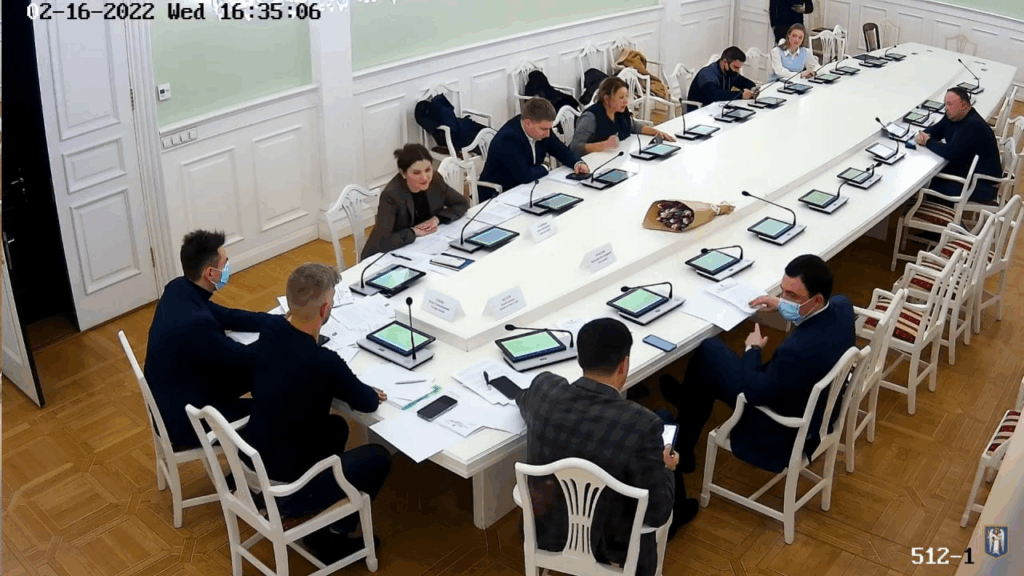
The first analyzed case occurred shortly before the full-scale Russian invasion. On February 3, 2022, speaking at a plenary session of the Kyiv City Council, Mykola Tyshchenko, a People’s Deputy of Ukraine from the Servant of the People party, called one of his colleagues “a girl who smiles during the war.” On February 16, the Kyiv City Council Standing Committee on Rules of Procedure convened a meeting[1] regarding a violation of the code of parliamentary ethics. Tyshchenko (or his representative) was invited to participate in the meeting “both officially and publicly.” The MP did not appear in person; his assistant took part in the meeting. On Tyshchenko’s instructions, “in order to prevent any political speculation,” he handed over the bouquet to MP Dinara Tarlan, although according to the chairman of the committee, the address was addressed to another MP.
When asked whether he considered this statement to be discriminatory, Tyshchenko’s assistant replied:
“I was not present at the meeting. Well, if it was an address to the audience, if we cannot establish who the statement was addressed to, he could have said “woman,” “madam,” “girl.” He addressed them, I believe, this is not a violation. It’s like “sir,” “guy.” Mr. Tyshchenko respects women very much, everyone knows it, all of Kyiv knows it, how he congratulates everyone.”
This answer suggests that the People’s Deputy does not see signs of sexism in his statement and does not admit that he was wrong. The chairman of the commission once again clarified whether Mr. Tyshchenko considered the expression “smiling girl” discriminatory, to which his representative clearly replied that he did not.
Later, Tyshchenko’s assistant, Ms. Evelina, who participated in the meeting, also spoke. She also did not see anything offensive in this statement:
“Such a gesture is not a conflict or some kind of mockery, as some representatives of the Kyiv City Council are trying to speculate again. As a girl, I can also assure you that this is not offensive and Mykola Mykolayovych did not have anything wrong with him in any way and did not violate, I am sure, any political ethics.”
It is ironic that Ms. Evelina tried to change the focus of the discussion and accuse all the deputies of the Kyiv City Council, who allegedly made noise during Tyshchenko’s speech, of violating parliamentary ethics:
“But at the same time, I think that perhaps we should consider a violation of political ethics: when a people’s deputy speaks, and other deputies of the Kyiv City Council make noise, treat each other with contempt, it was very loud. I think that this is really disrespect for each other. Perhaps, of course, noise is not regulated, but there are some non-verbal rules that, I think, were violated. Therefore, this gesture with flowers is an exclusively friendly gesture towards Ms. Dinara.”
When asked whether she personally finds Tyshchenko’s statement offensive, Ms. Evelina replied that she did not:
“For me, as a citizen of Ukraine and a woman, it is not offensive, because I believe that in that sense there was no offense. Mykola Mykolayovych in no way wanted to offend anyone, because he treats every person with respect, according to any of his colleagues, so no”.
Even more interesting are the assistant’s thoughts on the situation with gender equality in Ukraine, which she voiced when answering the question about what gender discrimination and sexism are. Ms. Evelina is convinced that such phenomena simply do not exist in Ukraine and we are incredibly lucky with this:
“I think that, probably, we all understand that in our country it is very rare when women or men are discriminated against on the basis of gender or some other… well, we are probably lucky, but in our country it is not developed. We have a very large female quota, all women are treated very appropriately, responsibly and with respect. Therefore, I believe and am very proud that there is no such thing in our country, I have never encountered such a thing.”
Meeting of the Kyiv City Council Standing Commission on Rules of Procedure, Deputy Ethics and Corruption Prevention. February 16, 2022
The coordinator of the secretariat of the Kyiv City Council’s MFO “Kyiv — for Equal Opportunities” noted that the MFO had prepared a statement from 56 deputies who are members of it, stating that they categorically condemn such behavior and consider it unacceptable not only within the walls of the Kyiv City Council, but also in the political space of Ukraine in general. She called for support for the MFO’s statement and emphasized the importance of a personal apology from the deputy through a public statement.
As a result, the commission voted to:
1) recognize the inadmissibility of any statements of a discriminatory nature from persons participating in Kyiv City Council meetings;
2) condemn Tyshchenko’s statement and recommend that the Kyiv City Council leadership contact Tyshchenko if he still participates in Kyiv City Council meetings to apologize to the Kyiv City Council and individual deputies;
3) recommend that the Kyiv City Council leadership apply the rule of immediately stopping the speech in case of relevant discriminatory statements.
After this meeting, there were no more personal apologies from the people’s deputy. Overall, this situation very successfully demonstrates that Tyshchenko’s sexist statement is not at all an accident or a failed communication, which he sincerely regrets. Judging by what his assistants, who represented his views, said at the commission meeting, Tyshchenko never understood what was wrong with his words. The gift given by the MP is more like a “kind gesture” on his part, to gently smooth over sharp corners and prevent public publicity of the situation, which could negatively affect his reputation.
“Sincere apologies for sincere impressions in an unacceptable form”
A somewhat different strategy of sexists’ behavior can be traced in the situation with Oleksandr Kornienko and Davyd Arakhamia, which, unlike the previous one, has spread widely online. The party chairman and the head of the Servant of the People faction discussed their colleague Iryna Allahverdiyeva and resorted to obvious sexism. This was broadcast live on YouTube, so the situation quickly gained mass publicity, and the politicians were sharply criticized.
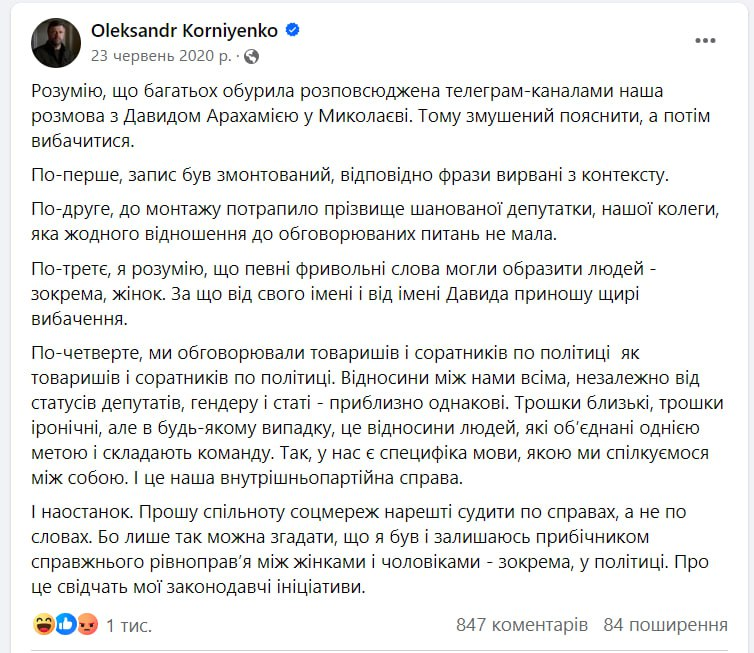
What was the reaction of the main sexist characters? That same day, Kornienko wrote an explanation and apology on Facebook[2] and gave several arguments in his favor.
Oleksandr Kornienko’s first post about sexist statements
First, he chose self-defense and stated that the recording was edited, phrases were taken out of context, and the colleague’s name had nothing to do with what was discussed in the private conversation. Regardless of its content, the very fact of the excuse indicates that the politician realizes that such statements will not find support among the electorate. Therefore, he does not try to defend his beliefs, but immediately renounces them.
Secondly, in this post, he expresses “sincere apologies” on his own behalf and on behalf of Arakhamia, because he understands that “certain frivolous words could offend people, including women.” In conclusion, after making excuses about the “specificity of language,” Kornienko calls on the social media community to “judge by deeds, not by words” and emphasizes that his legislative initiatives demonstrate that he continues to be a supporter of “true equality between women and men, particularly in politics.”
The next day, Kornienko took another step — recorded a video address[3] entitled “I will try to put an end to the history of my inappropriate conversations.” From the first seconds, it is noticeable that his arguments have changed somewhat over the past day: here he apologizes to his colleague for “that first small, short part of the conversation, where Arakhamia and I discuss our impressions, actually, of her beauty, charm, but in a completely unacceptable form.” The deputy admits that he had nothing bad in mind, and such words are his sincere impressions of his colleague’s appearance. And he declares that the next part of the conversation is not about Iryna, but about Tetyana Dombrovska, who impressed Kornienko with “her energy, her enthusiasm.” Here he also admits that the form he chose for this was unacceptable and sometimes offensive, which can indeed be perceived as sexism. In conclusion, Korniyenko admits: “I allowed myself sexist, discriminatory, disrespectful statements, for which I sincerely apologize.”
As we can see, this politician’s strategy is different. Unlike Tyshchenko, who is not ready to admit that he resorted to sexism, Kornienko does come to it. Yes, not immediately. The first post of a people’s deputy is rather an infantile justification and clumsy attempts to remove responsibility from himself and shift it to editing. However, very quickly, either under the pressure of public condemnation or out of fear for his political future, the deputy publicly admitted that his statements contained signs of sexism, and apologized for them. According to the proposed classification of behavioral strategies, the first reaction is closer to the second strategy (justification, refutation), and the reaction on the second day is closer to the first (admission, apology).
Sexists who do not hide it
Although I do not want to talk about Arestovych again, each of his reactions to accusations of sexism successfully and clearly demonstrates the third model of behavior of sexist politicians. This category includes those who can be described with the phrase “Yes, I am a sexist and I am not ashamed of it”. Former non-staff advisor to the President’s Office Oleksiy Arestovych last year became the laureate of the anti-award “Sexist 2022” and, as can be seen from his reaction, is proud of it.
Oleksiy Arestovych’s reaction to his leadership in the anti-award “Sexist of the Year”
Not once after his numerous sexist statements and the public criticism that followed them, has Arestovych even tried to refute what was said, justify himself or deny it. Obviously, there is no question of a public apology. He firmly stands by his position and usually reacts with another sexist statement. This type of behavior indicates that, firstly, the hero is sincerely convinced of the correctness of his views and is ready to persistently defend them; secondly, he uses the label of sexist as part of his image, an inalienable attribute of his persona.
Oleg Lyashko’s public sexist statements and his reaction to accusations of sexism are another example of this strategy. For example, in 2019, Lyashko addressed People’s Deputy Alona Shkrum from the rostrum of the Verkhovna Rada:
“When I look at you — a wonderful, young, intelligent woman who comes here and reports on the laws on civil service and local self-government, I have one question for you: Have you worked for even a day in state bodies or in local self-government bodies?”
Undoubtedly, such rhetoric discredits the deputy, it is sexist and unacceptable within the walls of the highest legislative body of Ukraine. Iryna Gerashchenko pointed this out to the deputy and urged him to speak objectively about the bills, “and not about the age, gender, beauty or unbeauty of the representative of parliament.” Lyashko’s answer illustrates very well how he understands sexism:
“Dear colleague, she is young, smart, beautiful, if this is sexism, if this is an insult, if I have to apologize for these words of mine, then I don’t understand what kind of world we live in. What should I have told her – an old witch or what?”
Such an answer shows that the people’s deputy does not see the problem in his words at all. Unlike Tyshchenko or Arakhamia, who seemed to be trying to take a step forward, ineptly apologizing, or a step back, renouncing their words, Lyashko does not understand the reasons for the accusation and is trying in every way to attack in response.
This is not the first time that such behavior has been observed. A few years before that, Lyashko used feminine pronouns with mockery (“vice-deputy”), deliberately distorted the surname of a female deputy (“Klympush… Tsitskadze”) and never apologized for it. That is, the people’s deputy is so convinced of the correctness of his position that he is not even afraid of the risk of public condemnation. Or, like Arestovych, he deliberately uses sexism as part of his political image.
Among the recent cases is the reaction of Lutsk Mayor Ihor Polishchuk to the “Reverse Day” flash mob in one of the city schools. At an operational meeting on June 5, the mayor stated that “when a male person wears women’s clothing, it is a perversion.” In response, one of those present at the meeting commented:
“The trend towards changing women’s clothing to men’s… it seems to have come from Europe. We missed some certain points during Covid, because distance learning made its own conclusions, and thus such days for changing clothes for men and women were introduced somewhere in educational institutions. But I will say that these trends, they say, have their own basis, subtext. Regarding 24 schools, this is a day of gender equality, which focused on children supporting each other in this part of gender equality, men, women, and so on. But you understand that these scenes of children changing clothes were taken out of context…”
Operational meeting in the Lutsk City Council
Yes, this cannot be called a decisive accusation of the mayor in sexism. The response from the audience is rather uncertain attempts either to justify the school administration by blaming the pandemic, or to explain the “European” origin of the values of gender equality. However, for this study, the reaction and response of the mayor are much more important. He stated:
“These values, these trends—they are foreign to us. These are not our values, these are not our trends. We a Christian city, and we have a city of normal values. These are not our tendencies, remember that.”
That is, Polishchuk also does not even try to justify himself or, even less, apologize for his sexist statements — he confidently defends his beliefs about “traditional values.”
Sexists who “do not notice” accusations of sexism
Finally, another model of behavior of politicians who are accused of sexism is the lack of any reaction to these accusations. Those who belong to this category are probably the most numerous. Among the clear examples, we will recall the manifestation of “benevolent” sexism by the mayor of Lviv, Andriy Sadovy, when he addressed the female deputies: “Girls, do not quarrel.” His colleagues stated[4] that such appeals are unacceptable and Sadovy should publicly apologize. However, there was no further communication: either an admission of his mistake, an apology, or an explanation — from the mayor.
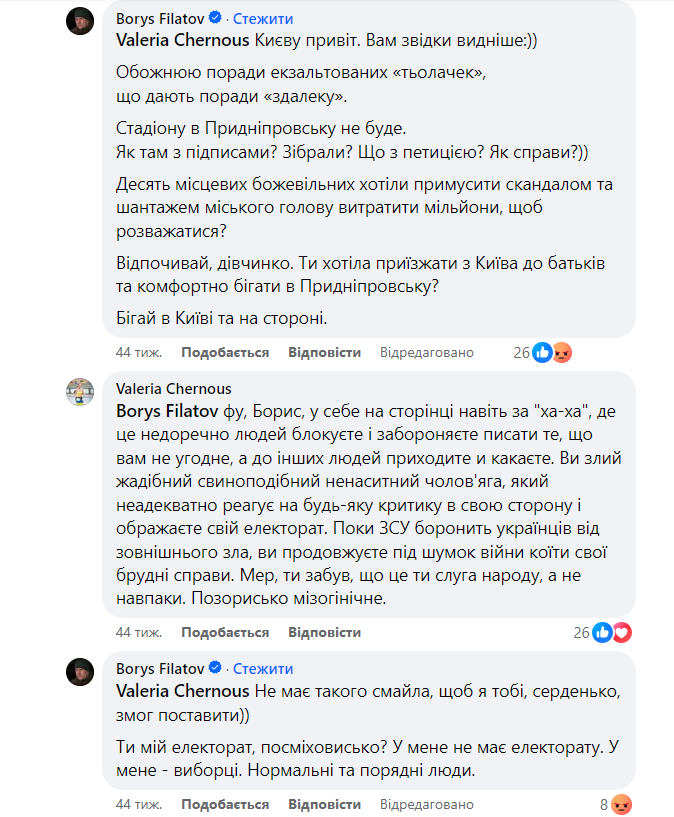
A prime example of hostile sexism is the communication of the mayor of Dnipro, Borys Filatov. The mayor has repeatedly allowed himself misogynistic and offensive comments on social networks and has not responded in any way to criticism and accusations of sexism. For example, in the comments under A. Gorba’s post, Filatov addressed the commentator as an “exalted “heifer”” who gives advice “from afar”; “little girl.” After the woman reacted to his statements and pointed out their misogyny, Filatov continued: “There is no such emoticon that I could put on you, my dear)) Are you my electorate, a laughing stock? I do not have an electorate. I have voters. Normal and decent people.” The following commentators also noted the inadmissibility of such communication for the mayor, but all these remarks remained without a reaction and response from Filatov.
Filatov’s misogynistic communication on social networks
Another example of ignoring the accusations and the lack of any reaction is the communication of the head of the Mykolaiv Regional State Administration (then the Regional State Administration, not the Water Administration) Vitaliy Kim. Back in February 2021, at the All-Ukrainian Forum “Ukraine 30”, Kim, speaking about the region’s tourism potential, mentioned “the most beautiful girls in all of Ukraine” several times as one of the region’s advantages and a reason “to invest in places such as hotels, souvenir shops, catering establishments, whatever.” These statements did not go unnoticed by civil society, and Kim was criticized for sexism. However, he did not react to these accusations in any way, did not admit guilt, and did not apologize. In subsequent posts about the Forum on the official Facebook page, Kim summed up and outlined the main points of his speech, but neither the “most beautiful girls” nor an apology for these words were mentioned. The head of the Regional State Administration probably does not see a problem with them or simply decided to ignore them.
Conclusions
Therefore, this study proposed to consider how politicians who directly resort to it understand sexism. Analysis from this angle allows us to assess how deeply sexists are convinced of the (in)correctness of their views, whether they are ready to defend them in response to public condemnation, or whether they abandon them after the first comment, which may threaten their rating.
Using the inductive logic of the analysis, the behavior patterns of sexists were classified after their sexist act/words became public and were criticized. The first category included those who publicly admit their wrongdoing and try to apologize for their actions or words. It is important that this study did not focus on evaluating these apologies, but on the behavioral strategy itself.
The second category includes those who try to deny or justify their actions. Such sexists usually resort to explanations such as “it was taken out of context,” “you misunderstood me,” or “that’s not what I meant.” Again, the study makes no attempt to assess the sincerity of their beliefs and the depth of their awareness of their guilt vs. fear of ratings. The focus is on the fact that they do not like the label of “sexist,” from which they try to distance themselves.
The third category includes those who can be characterized by the phrase “yes, I am sexist, and I am not ashamed of it.” Here, everyone who does not question the correctness of their views and after public condemnation usually makes even more sexist comments and actions.
Finally, a separate category was identified for those who take an ambivalent position and do not react to accusations of sexism. They simply ignore any criticism, do not apologize or defend their views. In such cases, it is difficult to understand the motives of actions, or rather their absence. Although it can be assumed that the representatives of this category are not so deeply convinced of their views as to endanger their reputation, and are not so brave and aware as to admit their wrongdoing and apologize.
Such a categorization of the behavior and communication strategies of sexists, of course, does not give a complete picture of the motives and beliefs of all politicians regarding sexism. However, it can be used to analyze reactions and make assumptions about how those who resort to sexism understand this phenomenon.
This project is implemented with the support of the Swedish Institute.
[1] Online broadcast of the PC of the Regulations 02/16/2022. Online broadcasts Kyiv City Council.
[2] Oleksandr Korniyenko’s first post about his sexist statements. Oleksandr Korniyenko, 06/23/2020.
[3] Oleksandr Korniyenko’s second post about his sexist statements. Oleksandr Korniyenko, 06/24/2020.
[4] Olha Berezyuk’s post about accusations of sexism and the appropriateness of an apology. Olha Berezyuk, 08/13/2021.