
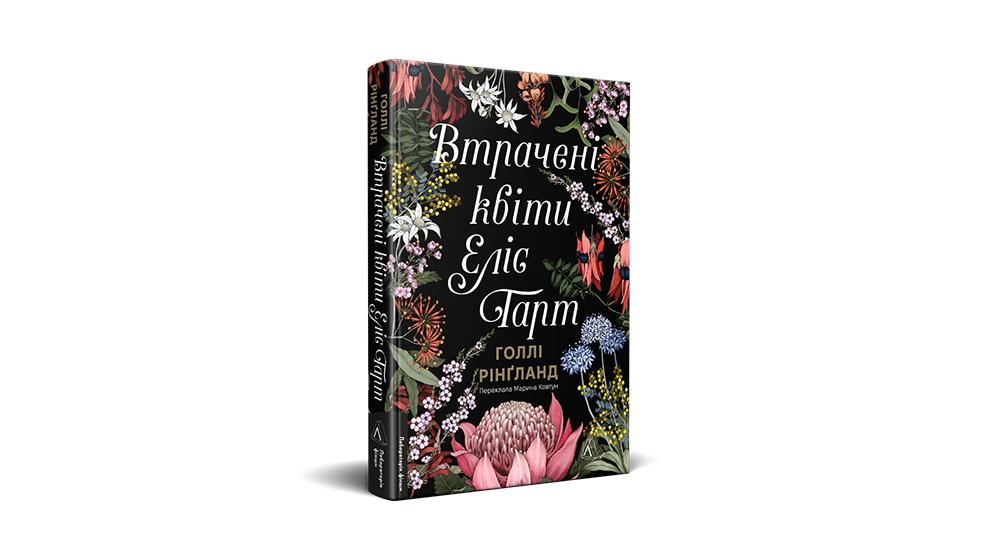
On the coast of Australia, many, many miles from the nearest town, in a house filled with the love of her mother Agnes and the cruelty of her father, lives nine-year-old Alice Hart. Her mother’s beautiful garden is the only place where she can be unafraid, hiding from sudden outbursts of anger. Until a fire, bringing with it inevitable tragedy and death, forces Alice to abandon everything she feared so much and at the same time loved so much.
The novel “The Lost Flowers of Alice Hart” by Holly Ringland, soon to be published by the Laboratory Publishing House, is the story of how, over twenty years, between the lush sugarcane fields on the seashore, between an Australian flower farm and a celestial crater in the central desert, Alice is forced to understand that the most powerful story she will ever own is her own. We publish an excerpt from the book.
Alice followed Candy past the dormitory where the Flowers lived. When they reached the workshop, they stopped at a door that was covered in thick vines. Candy pushed it aside, took her keys from her pocket, and inserted one into the keyhole.
“Ready?” she asked, smiling broadly.
The door opened.
They stopped together at the doorway of the workshop. The morning sun warmed their backs, but the air conditioning in the room made Alice suddenly feel cold. She rubbed her hands together, remembering the boy who had raised his hand to wave.
“You sighed so deeply,” Candy raised an eyebrow, looking at Alice. “Are you okay?”
Alice wanted to say so much, but all that came out was another sigh.
“Words are sometimes overrated,” Candy said, and took Alice’s hand. “Don’t you think so?”
Alice nodded. Candy squeezed her hand before letting go.
“Come on,” she said, holding the door open, “let’s take a look around.”
They went inside. The first half of the workshop was filled with benches stacked like a tower of buckets, a row of sinks, and refrigerators along the wall. On the shelves were tools, rolls of sunscreen, and assorted bottles and spray cans. On hooks on the wall hung wide-brimmed hats, aprons, and gardening gloves, beneath which stood rubber boots, lined up like invisible flower soldiers, frozen in place on the rack. Alice turned back to the benches. Under each of them were additional shelves filled with jars and containers. The workshop smelled of fertile soil.
“We bring the flowers here after we cut them in the fields. We inspect each flower before we send them on their way. They have to be perfect. We get orders from customers all over the country; our flowers are delivered to every corner of the country, to flower shops and supermarkets, to gas stations and market vendors. They are worn by brides and widows and,” Candy’s voice trembled, “women who have just become mothers.” She ran her hand along one of the benches. “Isn’t it magical, Alice? The flowers we grow here speak for people when words can’t, in almost every situation imaginable.”
Alice repeated Candy’s motion and ran her hand along the work surface. Who are the people who send flowers instead of words? How can a flower say the same thing as a word? What would one of her thousand-word books be like if it were written in flowers? No one ever sent her mother flowers.
She squatted down to examine the boxes of cutting tools, the spools of string, and the little buckets of markers and pens of all colors under the bench. She took the cap off the blue marker and sniffed it. On the back of her hand she drew a circle, a straight vertical line, and then another, a slant, the letter “I.” In a moment she had added a dash and the word “t-u-t.” As Candy approached her, Alice erased the words.
“Shh. Alice Blue,” Candy stuck her head out over the bench where Alice sat. “Follow me.”
They made their way between the benches, past the sinks and refrigerators, to the other side of the workshop, which was set up as an art studio. There were tables covered with plain tablecloths, strewn with paint cans and paintbrushes. In one corner stood easels, stools, and a box filled with tubes of paint. On one of the tables lay rolls of copper foil, pieces of colored glass, and jars of tools. When Alice reached the closed corner at the end of the studio, she forgot about the boy. She forgot about June and the statues of her father. She was too absorbed in what was right in front of her.
“The corner under the letter “X,” Candy giggled.
Dozens of flowers in various stages of drying hung from a frame overhead. A long bench ran along a makeshift wall. On it lay tools and fabrics, blackened by frequent use, and dried flower petals, scattered, discarded like clothes abandoned on a beach. Alice pressed her palms to the wooden surface, remembering her mother’s hands floating over the flower heads in the garden.
At one end of the bench lay a velvet sheet adorned with bracelets, necklaces, earrings, and rings decorated with pressed resin flowers.
“This is June’s place,” Candy said. Here she creates magic from the stories that Thornfie is built on.ld.
Magic. Alice stood before the jewelry, each shimmering in the light.
“June grows every flower here,” Candy said, holding up a bracelet that held a pendant with a pale peach petal. “She presses each petal and pours it in clear resin, then seals it in silver.”
Candy replaced the bracelet. Alice studied the rainbow of other flowers pressed into the pendants of the necklaces, earrings, and rings. Each flower was sealed forever, frozen in time, but still holding the colors of life. They would never turn brown or wither. They would never rot or die.
Candy moved to stand beside her.
“In the days of Queen Victoria, people in Europe spoke through flowers. It’s true. June’s ancestors—your ancestors, Alice—women who lived a long time ago brought this language of flowers from across the ocean, from England, and preserved it for generations until Ruth Stone brought it here to Thornfield.
They say she didn’t use it for a long time. It wasn’t until she fell in love that she began to speak in flowers. However, unlike the language of flowers she brought from England, she only used the flowers her lover gave her.” Candy stopped, her face turning red. “Whatever…” she interrupted herself again.
Ruth Stone. Her great-grandmother. Alice’s cheeks flushed with curiosity. She wanted to put a ring on each finger, press cool silver pendants against her warm skin, throw bracelets on her wrists, and press earrings into her unpierced ears.
She wanted to carry the secret language of flowers around her, so that they could say for her what her voice could not.
At the other end of the bench lay a small handmade book. Alice leaned over it. The cracked spine had been repaired many times, tied with many red ribbons. The inscription on the cover was handwritten, in gold calligraphy, with red flowers that looked like spinning wheels. “The Language of the Australian Wildflowers of Thornfield.”
“Ruth Stone was your great-great-grandmother,” Candy said. “This was her dictionary. Ruth’s heirs cultivated language the same way they cultivate flowers here,” she ran her hand over the corners of the worn pages. “It has been in June’s family for generations. Or rather, in your family,” she corrected herself.
Alice ran her fingertip over the cover. She wanted to open it, but she wasn’t sure if she could. The pages were yellowed and stuck out at odd angles. There were bits of handwritten words in the margins. Alice tilted her head. She could only read a few complete words. Darkness. Branches. Crumpled. Fragrant. Butterflies. Paradise. It was the best book Alice had ever seen.
“Alice,” Candy leaned down so that she was at Alice’s eye level. “Have you ever heard that story before? About Ruth Stone?”
Alice shook her head.
“Do you know much about your family, Pea?” Candy asked gently.
A feeling of shame that Alice couldn’t understand made her look away. She shook her head again.
“Oh, what a lucky girl,” Candy smiled sadly.
Alice looked at her in confusion. She wiped her nose with the back of her hand.
“Do you know Alice Blue, the woman I wrote to you about in the letter, the daughter of a king?”
Alice nodded.
“Her mother died when she was little,” Candy took her hand. “She was heartbroken and sent to live with her aunt, in her palace filled with books. Later, when Alice Blue was older, she said that it was the stories her aunt told her and the stories she read in books that saved her.
Alice imagined Alice Blue, a girl in a dress the color of her name, reading in the pale light that filtered through the window onto the pages of a book.
“You are lucky to have found this place, and with it your story, Alice. How lucky you are to be able to know and understand where you come from and where you belong,” Candy turned her face away. In a moment, she wiped her cheeks.
Air conditioners clicked and hummed in the distance. Alice looked at the old book and imagined women who had bent over it long ago. Perhaps they were clutching a sprig of wildflowers in their hand to add a new entry in their secret language.
Alice began to shift nervously from foot to foot, because she was bored. Candy turned to her and asked a question that filled Alice’s whole body with impatience:
— Do you want me to show you how to get to the river?
You can purchase the book at the link on the Laboratory publishing house website.



Leave a Reply