
On February 8, 2024, the official website of the Ukrainian Orthodox Church of the Kyiv Patriarchate (UOC-KP) reports, “His Holiness Patriarch of Kyiv and All Rus’-Ukraine Filaret awarded medals for “Sacrifice and Love for Ukraine” to the entire personnel of the medical post of the 1st mechanized battalion of the 72nd separate mechanized brigade named after the Black Zaporozhians of the Armed Forces of Ukraine.” And already on February 25, the UOC-KP announced that they were canceling this award for one of the awardees, Viktor Pylypenko, because they “do not share his sinful preferences and LGBT agitation.” In other words, Viktor Pylypenko was recognized as unworthy of the medal because of his sexual orientation, because he is an open activist for the rights of LGBT+ people, one of the founders of the association “Ukrainian LGBT Military for Equal Rights.”
It is no secret that the UOC-KP and other religious institutions are the most ardent opponents of the promotion of LGBT+ rights in Ukraine. Not so long ago, a scandal erupted over a video clip featuring Khrystyna Solovyi and Serhiy Zhadan, filmed in Lviv in the church of St. Andrew the First-Called, which showed two girls kissing. For years, the Council of Churches opposed the ratification of the Istanbul Convention on Combating and Preventing Gender-Based Violence by the Verkhovna Rada, because this document allegedly promotes “gender ideology” and “non-stereotypical gender roles,” and now it is actively opposing the legalization of civil partnerships. And when in 2023 the Pope allowed the blessing of same-sex couples, the Ukrainian Greek Catholic Church was quick to make a statement that Rome’s will does not apply to it.
Being a believing LGBT+ person in Ukraine is obviously very difficult. It’s one thing if you are an atheist and what Church representatives write on the Internet is offensive to you at best, and more often seems like outdated anti-scientific nonsense, the main problem of which is the delays in advancing LGBT+-friendly legislation in Ukraine. But what about a person for whom the Orthodox or Catholic, Muslim or Jewish part of the personality is as integral and important as national identity or sexual orientation? What is it like to feel and understand that a community that is important to you stops accepting you simply because of who you are from birth? And how is it that people who profess religions that are based on love for their neighbor so easily allow themselves to push away and be cruel to people for something that should not concern them: because of their romantic feelings or how they express their gender?
These questions have been bothering me for some time, and a few years ago I began to take an active interest in welcoming, inclusive churches and religious institutions of various faiths. As it turned out, some religious communities have nevertheless taken a step forward towards a more inclusive interpretation of their own religious texts and acceptance of human diversity. In this text, I would like to share a few stories that, in my opinion, best illustrate that religion can truly be about love and acceptance, and not about stigmatizing those who do not fit into the rigid framework established by the Church. And most importantly, I have decided not to write about progressive churches in Sweden or Iceland, from which everyone probably expects, first of all, tolerance and openness to the new. I want to show you that acceptance can also be found in less predictable places. For example, in very Catholic Latin America or in South Africa.
John Botja. Gay Pastor in Bogotá, Colombia
I met John a year ago when I came to Colombia to interview local LGBT+ activists. The topic of conversation turned to religion, which is an important part of national identity in Latin American countries, and my colleague mentioned an openly gay Methodist pastor she knew. I couldn’t pass up the opportunity and asked to share his contact information. John responded to my request to chat almost immediately and invited me to attend their service on Sunday morning. However, he warned me that, as a non-local, I should call a taxi or Uber and have the driver drop me off at the church door, because this area of Bogotá is not very safe.
The Methodist Church of Bogotá (Iglesia Metodista de Bogotá) occupies two small but bright premises in what is certainly not the most peaceful area of the city. If it weren’t for the cross on the roof and the sign on the door, I would never have guessed that this was a church: most of the visitors arrive on motorcycles and mopeds, dressed in leather jackets, many with piercings or tattoos. Although the church is open to all comers, the vast majority of the parishioners are LGBT+ people and their families and allies. John himself looks like an ordinary, nice young priest, the least striking figure in this diverse crowd.
An hour before the service begins, some people gather in a separate room for a Bible reading, and I join them to listen. Today’s topic of discussion is patience and acceptance. How do we explain our opinions without alienating them? How do we be open to a position that doesn’t coincide with ours? How do we understand those who hate us? It all feels more like a psychology debate club than a discussion of the truth.
liturgical texts. However, someone constantly reads passages from the Bible.
Service at the Methodist Church of Bogota
The service itself also somewhat resembles a rock concert. In addition to John, who conducts the service, there are two more girls in leather jackets in front of the congregation. One plays the bass guitar, the other plays the synthesizer. At some point, I myself sing along and dance to a song about how God is love. If it weren’t for this and the large number of men in leather jackets around, it would be no different from a regular Protestant service. After communion, everyone goes to the common kitchen to drink tea and cookies. I start a conversation with a couple next to me, ask who they are and how they came to church.
Everyone’s stories are different, but in general about one thing. Here is Luis from Venezuela, which he left due to the political and economic crisis in search of work in Colombia. The Catholic church at home was not even open to accepting him as gay, but faith had always been very important to Luis, so he looked for a way to join another church until he met John. Maria and Natalia are a couple who help John organize various events. This time they are collecting donations for a shelter for victims of domestic violence. They came to get John from their previous church, where they could not openly talk about who they were.
Finally, I have the opportunity to talk to John about his story.
“I grew up in a Catholic family,” he says. “I fell in love with another boy for the first time when I was about seventeen. I tried to suppress these feelings for a long time because I grew up knowing that it was a sin, that it was a crime to be attracted to someone of the same sex. I struggled with myself for several years, and at one point I even started dating another guy, but it felt like something terrible, a sin. I had to hide who I was from my church, and therefore lie. It killed me from the inside for several years, until I ended up in the hospital with a serious illness. And then, when I was lucky enough not to die, I said to myself: “Enough! If God made me this way, then this must be His will.” And I accepted myself. Then I started thinking: “I can’t be the only gay believer in Colombia!” And I started googling “gay Christians,” “LGBT+ believers,” “LGBT+ Christians,” and I saw a bunch of websites! I started writing to them, making my thematic posts on social media, and little by little I built a community that became almost a family. But what I was missing was ministry. And after years of searching, I joined the Methodist Church, where I started helping the pastor because this church accepted LGBT+ people, had female priests, and our values coincided. It so happened that this pastor was going to serve in Argentina, so he invited me to be ordained and take his place. On February 25, 2018, I became the first openly gay pastor in a Protestant church in Colombia and all of Latin America. Of course, there were other gay pastors before me, but their sexual orientation was hidden, and I became the first gay priest to be ordained, and everyone around me knew it. The whole world knows that I am gay.”
When I asked how his church is changing the world around him, John gives two answers:
“First, we try to change people by our example. When we moved into this building (in a poor neighborhood), people knew that I was gay and didn’t see me as a priest. They immediately thought of debauchery, drugs, alcohol, all these things that some still associate with homosexuality. But then they saw how we help children, women, young people who use drugs, anyone, and they started to respect us. Now they say: “Yes, this pastor has a different sexual orientation, but he is a good, decent person.” That’s how I gained people’s favor over these five years. Secondly, it’s education. I can’t do anything if people don’t understand the basic things: who is an LGBT+ person, what is sexual orientation, gender identity, what is it all about? We have to teach people what diversity is, tell them about the rights of LGBT+ people, why it is important. We need to talk more about our experiences and listen to the experiences of other people. If we are talking about transgender people, I will invite a transgender person to tell about their life, I can’t speak for them. We have to listen to each other. This is how we learn, this is how we become a better version of ourselves.”
And what if God is a transgender woman? Rita Gomez and Iglesia Antigua de Las Américas
Since I worked for several years in Ukraine in the Parental Initiative “TERGO”, which supports families with LGBT+ children, I was interested in talking to similar parenting groups in Latin America. That’s how I found Rita. But she turned out to be not just a lesbian mother and a named mother of a transgender woman, but also a bishop of the Ancient Church of the Americas (Iglesia Antigua de Las Américas). I came to Rita’s house, where I found her surrounded by several dogs and houseplants. The bright red-haired woman told me her story so emotionally and captivatingly that, sincerely rejoicing, I turned on the recorder with her permission, because it was impossible to take my eyes off her and record something.
“The way we see the world depends on where we come from. I am from Osho.
a rich family: my dad and mom were poorly educated people, but, on the other hand, had a fairly liberal mindset for their time. Our home was always a safe place for LGBT+ people, they were part of the environment in which I grew up. They were not strangers, they were part of my family, my dad and mom’s friends, or the children of those friends. It was natural, normal. I myself was not born into a Catholic family. Let’s say, 70% of people in Latin America are believers. A large percentage of them are Roman Catholic. But my parents belonged to the Presbyterian Church, which was already quite progressive in matters of female leadership. Somehow it happened that for me in the church there was no question at all that something was not allowed. So I was a deaconess, I was a pastor, I was a reverend, because women have the right to be ordained just like men. But many churches still fail to understand and accept the issue of gender diversity. Eight years ago, I belonged to the Presbyterian Church. In general, women are welcome in the church, but not everyone in the church sees the issue of sexual diversity the same way. Eight years ago, someone from the church said to me at a leadership meeting: “Rita, I’m praying for you, because you must be really hurt by this.” I ask what exactly hurts me. And she says to me: “Do you know that your daughter is a lesbian?” I look at her and realize that this is my moment. And I tell her: “Of course I know. I knew from the moment she was born and everyone in the family knew, and no one has a problem with it.” And everyone around me fell silent, somehow very awkwardly. And the next week, the pastor invited me for coffee and said that the church was not happy. “So,” I say, “you’re not ready to accept my daughter anymore? My daughter grew up in church, was the youth coordinator of the church, organized meetings for two hundred people. And by Saturday my daughter was an example for everyone, and the next week she was asked not to come to church because, you see, she was not good enough!”
That day I decided that this was not my place. If there is no room for everyone where there is communion with bread and wine, this is not my place. If you are required to be a heterosexual person to be part of the community, this is not my community. And so I left. For a year I went to a Methodist church that accepts LGBT+ people. I sat in a corner for a whole year, learned a lot during the sermons. Then I felt that I wanted more, and then I met a wonderful woman named Gabriela Guerreros and a wonderful man named Hugo Cordoba Quero. Two wonderful theologians from Argentina. She is a lesbian who built a whole process called Las casitas. Casitas are shelters for people with transgender experiences and substance abuse issues. Hugo and Gabriela introduced me to Iglesia Antigua de Las Américas, and I immediately fell in love and joined. Three years ago I started serving, and after a while I was asked to become a bishop in Colombia. It was not easy for us, because our Church challenges traditional religious models.
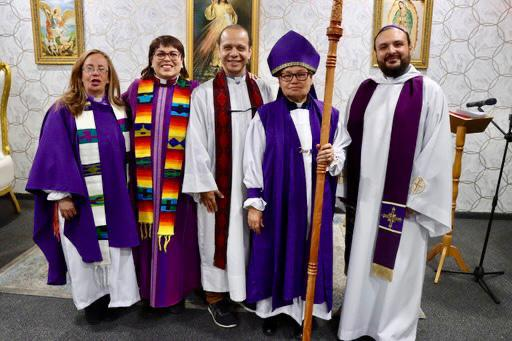
Rita Gomez (far left) in August 2023 after her ordination as a bishop. Source
First, we are pro-abortion as a church. We believe that women are the only ones who have the right to decide whether or not to have an abortion, and we believe that we cannot allow women to continue to die from clandestine abortions, we cannot allow raped girls to give birth at the age of eight. As a church, we consider ourselves people who support legal, free, safe, permitted abortions with consent, with guarantees as a woman’s right. And we also think about how important it is to approach a person’s decision to undergo euthanasia with understanding. When a person is suffering, who am I to force them to live, because otherwise they will go to hell? Moreover, we do not believe in hell.
Hell is a religious construct that was invented to control people. If you are gay, you will go to hell, if you are a lesbian, a socialist, if you decided to have an abortion or euthanasia, you will also go to hell. Hell is a social, even political construct that the religious world created to rule over people. I have never believed in the idea of hell. I believe in a theology called realized eschatology. Hell is here and now. Hell is starving to death, it’s being a mother of two or three children at 16 and not being able to go to school. Hell is a 50-year-old woman who can’t read or write. That’s what hell is. But we love drama, give us flames and a red devil with horns and hooves.”
Rita then enthusiastically recounts her experience speaking to the participants of Pride in Bogotá:
“I’ve never had the opportunity to talk about God to more than 10,000 people in my life, I only had three minutes. I took the microphone and said, “I know that 90 percent of those present think that God is the biggest symbol of patriarchy in the world, because all our lives we’ve been told that God is a man. I want to tell you that God is Love, that’s what the Bible says, and love doesn’t hurt, because love cares, protects, builds. How many of you have had to explain your diverse lives to a religious person only to be told…
and did you accept this?” Everyone in the square raised their hands. “I want to tell you that being different from others is not a sin or a crime. A crime and a sin is when a supposedly believing person takes advantage of the vulnerability of a child, woman, or young man to satisfy their sexual needs. Today I want to show you that God is a God of diversity. I believe that God is trans. I believe this and I say this seriously. After all, God had to make a transition in his eternal essence to a temporary physical incarnation in Jesus, had to stop being an absolute power in order to become a man who died, starved, suffered, cried, and feared death on the cross. God created the transition. God also travels in the Holy Spirit after the death of Jesus and accompanies us. The Holy Spirit accompanies us. Period! Wherever we go and whoever we are. God makes the transition. Now it is up to us, the new generations and those who think differently, to let God pass through our lives and accept His love, understanding that we must love ourselves in order to be able to love others as well.” And when I saw the wild reaction of the crowd, how people reacted to my words, I realized what uncontrolled power the religious world can have over other people. And that day I asked God to help me better determine how to accompany people more carefully in their transition, because it is a huge responsibility.”
Judaism: Reform Jews
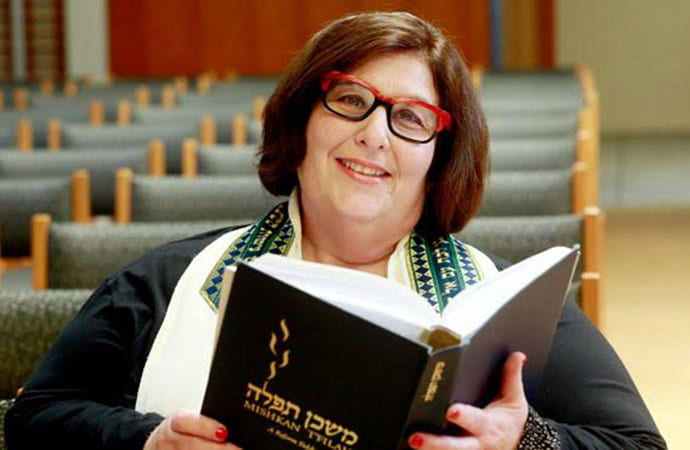
Quite by chance in the middle of 2010, I rented an apartment in Berlin from a Jewish woman who turned out to be not just a slave, but also the first female slave in the (then) CIS countries to perform a religious wedding ceremony for a lesbian couple. That’s when I learned about the existence of a branch of Reform Judaism, which, unlike Orthodox Judaism, supports the rights of LGBT+ people.
Reform Judaism has its roots in Germany, where it originated quite a long time ago, back in the 19th century, and from there it spread to other countries in Central and Western Europe. It is now very popular in the United States and has about two million followers worldwide. The movement of progressive or Reform Judaism is a liberal trend in Judaism. Such Judaism believes that Jewish tradition is constantly evolving, acquiring new meaning and new content with each new generation, therefore it strives to renew and reform religious rites in the spirit of modernity.
Reform Judaism has been advocating for LGBT+ rights since 1965, when the Women of Reform Judaism (WRJ) passed a resolution calling for the decriminalization of homosexuality. In 1977, the Central Conference of American Rabbis and the Union for Reform Judaism passed their first resolutions calling for equal rights for homosexuals. Since then, American Progressive Jewish organizations have passed a series of resolutions on issues such as the inclusion of gays and lesbians in the rabbinate and cantorate, support for marriage equality, the elimination of discrimination in the military and Boy Scouts, and support for comprehensive nondiscrimination and civil rights legislation. In 2015, the Union for Reform Judaism adopted a resolution on the rights of transgender and gender nonconforming people, and the Religious Action Center recently published a Guide to Integrating Transgender People to help congregations better include them and their families.
While researching Judaism’s stance on homosexuality, I was intrigued to read an interview with Denise Eger, a female rabbi who began her work in 1988 at a gay synagogue in Los Angeles at the height of the AIDS epidemic. She traveled to the medical center every day to visit young patients being treated for the disease. She says that at that time, the fear of AIDS, especially for those living with it, was palpable.
Rabbi Denise Eger before a same-sex marriage ceremony. Source
Eger, who is the founding rabbi of Congregation Kol Ami, a Reform Jewish synagogue in West Hollywood, California, remains committed to helping those who are marginalized and uses her rabbinate as a platform for social activism. She is the president of the Central Conference of American Rabbis (CCAR), the largest and oldest rabbinical organization in North America. Eger is also the first openly lesbian rabbi to serve as the head of the Reform rabbinate.
The first gay imams: LGBT+ rights in Islam
It took a little longer for mosques to open their doors to LGBT+ people: the first LGBT+-friendly mosque in Europe with a gay imam of Algerian origin was founded in 2012 in Paris (at that time, several such mosques were already operating in Canada, the USA, and one of the first known gay imams opened such a mosque in South Africa).
Imam Ludovic-Mohamed Zahed says in his interview:
“Our mosque became the first inclusive mosque in Europe. Today, such communities exist all over the world: in Western Europe, the United States, Indonesia, South Africa, even in Tunisia. So it spread everywhere, but it started mostly in the USA and Canada […] It was the first time in my life that I was asked to perform the duties of an imam after I left





Leave a Reply